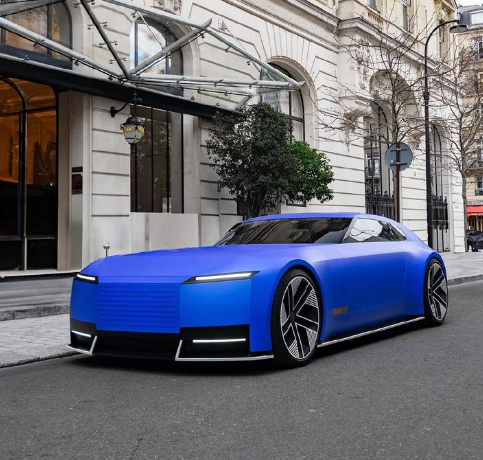
Jaguar has hit the reset button. The Jaguar Type 00 is not just a car; it is a manifesto for the brand’s total transformation into an ultra-luxury electric marque. First revealed at Miami Art Week in late 2024 and entering its final testing phase in early 2026, the Type 00 previews a four-door GT that aims to compete with Bentley and Rolls-Royce rather than BMW or Audi.
It is a radical departure from the “curvy” Jaguars of the past, embracing a philosophy the brand calls “Exuberant Modernism.”
Design: Brutalism Meets Luxury
The Type 00 is defined by its “monolithic” and “brutalist” styling. It prioritizes extreme proportions that feel more like a high-fashion concept than a traditional vehicle.
- The Silhouette: It features an incredibly long hood (the “prestige mass”) and a cabin pushed far to the rear, mimicking the stance of 1960s icons like the E-Type, but with sharp, geometric lines.
- The “Strikethrough” Motif: Horizontal slats dominate the front and rear. At the front, they replace the traditional grille, and at the back, they cleverly conceal the taillights.
- Glassless Rear: In a bold move for aerodynamics and privacy, the Type 00 has no rear window. Drivers rely on a “ClearSight” digital camera system that projects a high-definition view onto the rearview display.
- The New Face: The car introduces the new “JaGUar” typography and a reimagined “Leaper” logo that now leaps from left to right, signaling the brand’s intent to “leap forward.”
Engineering: The JEA Architecture
The production version of the Type 00 (scheduled for late 2026) is built on the proprietary JEA (Jaguar Electrified Architecture).
Performance and Power
- Tri-Motor Setup: One motor at the front and two at the rear provide intelligent all-wheel drive.
- Output: A combined total exceeding 1,000 hp.
- Driving Dynamics: Despite measuring over 5.2 meters (204 inches) in length, it features 50:50 weight distribution and six-degree rear-wheel steering to ensure agility.
- Chassis Tech: It uses an active air suspension system with twin-valve dampers (similar to the latest Range Rovers) to balance “magic carpet” comfort with high-speed stability.
Battery and Charging
- Range: Jaguar targets a WLTP range of 770 km (478 miles) or approximately 400 miles on the US EPA cycle.
- Rapid Charging: Its 850V architecture allows it to add 320 km (200 miles) of range in just 15 minutes.
- ThermAssist: A new thermal management system that reclaims waste heat to warm the cabin and battery, improving efficiency in cold climates by up to 40%.
The Interior: A Digital Detox
Jaguar’s vision for the cabin is one of “architectural serenity.” The interior is divided by a 3.2-meter-long hand-finished brass spine that runs from the dashboard to the rear seats.
Materials and Customization
- Sustainable Luxury: The cabin utilizes travertine stone, wool-blend fabrics, and alabaster totems rather than traditional plastic or carbon fiber.
- Hidden Technology: To avoid “screen fatigue,” the main displays are hidden behind panels that slide away when not needed.
- The Prism Case: This special compartment contains three material “totems.” When a totem is placed in the center console, the car’s ambient lighting, scent, and soundscape change to match the material’s mood.
Frequently Asked Questions
Is the Jaguar Type 00 a production car?
The Type 00 is a design concept, but it directly previews a production four-door GT that will launch in late 2026. Jaguar has confirmed that the production car will retain the concept’s extreme proportions and windowless rear.
How much will the production Jaguar Type 00 cost?
The upcoming GT is expected to start at approximately £100,000 (roughly $163,000 USD), positioning it as a competitor to the Porsche Taycan Turbo and Bentley Continental GT.
Why does it have no rear window?
By removing the rear glass, Jaguar’s designers were able to create a more aerodynamic “boat-tail” rear end and a more private, lounge-like atmosphere for rear passengers.
Where is the Type 00 being built?
The production models based on the Type 00 will be manufactured at Jaguar’s Solihull facility in the UK, which has been upgraded to support the new JEA electric platform.
What is the “strikethrough” design?
It is a repeating pattern of horizontal lines found on the front, roof, and rear of the car. It serves as a new brand signature, replacing the traditional mesh grilles of older combustion-engine Jaguars.