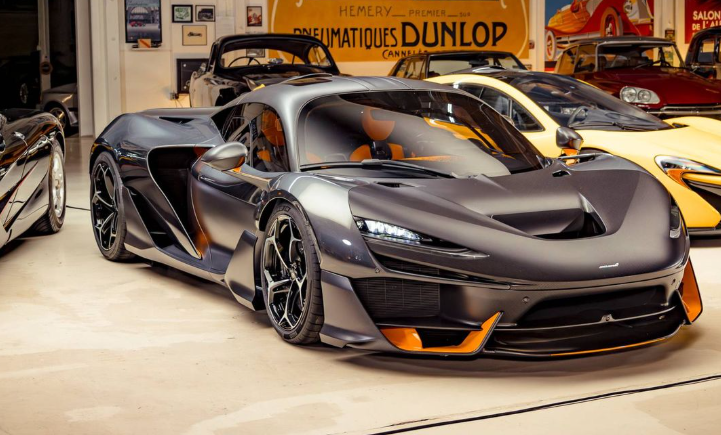
Following in the footsteps of the legendary F1 and the revolutionary P1, the McLaren W1 has arrived to redefine the boundaries of what a flagship hypercar can achieve. Launched to coincide with the 50th anniversary of McLaren’s first Formula 1 World Championship, the W1 is not just a successor it is a total technological overhaul designed to be the fastest-lapping, most engaging road car ever to leave Woking.
By focusing on the “Real Supercar” philosophy, McLaren has ignored industry trends toward heavy all-wheel-drive systems and instead perfected the rear wheel drive experience through extreme aerodynamics and lightweight hybrid power.
The Powertrain: 1,275 PS of Pure Precision
At the heart of the W1 is the all-new MHP-8 V8 engine. This 4.0-liter twin-turbo unit is the most power-dense engine McLaren has ever built, producing 928 PS on its own and revving to a staggering 9,200 rpm.
The Hybrid E-Module
The V12-rivalling power is supplemented by a motorsport-derived E-module.
- Electric Output: 347 PS (342 hp).
- Total System Power: 1,275 PS (1,258 hp).
- Total Torque: 1,340 Nm (988 lb-ft).
- Transmission: A new 8-speed dual-clutch transmission with an electronic reverse (E-reverse) and a hydraulic electronic differential.
Despite the electrical assistance, the W1 remains a pure rear-wheel-drive machine, proving that McLaren still prioritizes the driver’s connection over simple 0–100 km/h statistics.
Aerodynamics: The Shape-Shifting Longtail
The W1 is a “ground-effect” car, much like modern Formula 1 racers. Its entire design is sculpted to manage airflow from the front splitter to the massive rear diffuser.
The Active Long Tail Wing
The most dramatic feature is the McLaren Active Long Tail rear wing. Driven by four electric motors, it can extend rearward by 300mm.
- In Road Mode: The wing sits flush with the body for a clean silhouette.
- In Race Mode: The car physically transforms. The ride height drops (37mm front, 17mm rear), and the wing extends to act as an extension of the diffuser, helping generate a massive 1,000 kg of downforce.
Aerocell Monocoque
The bespoke McLaren Aerocell carbon fiber chassis is narrower and higher than previous models, allowing air to flow through the car rather than just over it. Even the anhedral doors (gull-wing style) were designed to optimize cooling for the high-temperature radiators.
Performance Benchmarks
The W1 isn’t just fast in a straight line; it is a track monster that has eclipsed the performance of the McLaren Senna.
- 0–200 km/h (124 mph): 5.8 seconds.
- 0–300 km/h (186 mph): Less than 12.7 seconds.
- Top Speed: Electronically limited to 350 km/h (217 mph).
- Lap Times: The W1 is 3 seconds faster per lap than the Senna on McLaren’s reference track.
Interior: Built Around the Driver
The interior of the W1 follows a minimalist, racing-first approach.
- Fixed Seating: To save weight and lower the center of gravity, the seats are integrated directly into the carbon monocoque. Instead of moving the seat, the driver adjusts the pedals and steering wheel.
- Tactile Controls: McLaren has kept the steering wheel free of buttons to prevent distraction, placing the “boost” and “aero” toggles as physical rockers at the top of the instrument cluster.
- Digital Rearview: Due to the extreme engine packaging and lack of a rear window, a dedicated digital display provides a constant high-definition feed of what’s behind the car.
Frequently Asked Questions
How many McLaren W1s will be produced?
Production is strictly limited to 399 units, and all have been allocated to customers before the official public reveal.
How much does the McLaren W1 cost?
The starting price is approximately $2.1 million to $2.6 million (roughly £2 million), depending on the market and MSO (McLaren Special Operations) customization options.
Is it faster than the McLaren P1?
Significantly. While the P1 was a pioneer in 2012, the W1 offers nearly 400 more horsepower and significantly more advanced ground-effect aerodynamics, making it much faster on both the track and in a straight line.
What is the electric-only range of the W1?
The W1 features a small 1.384 kWh battery designed for performance and weight saving. Its electric-only range is minimal, approximately 2 km (1.2 miles), intended primarily for silent starts or low-speed maneuvers.
Does the W1 have 4-wheel drive?
No. To maintain a low weight of just 1,399 kg and provide a traditional supercar feel, the W1 is exclusively rear-wheel drive.