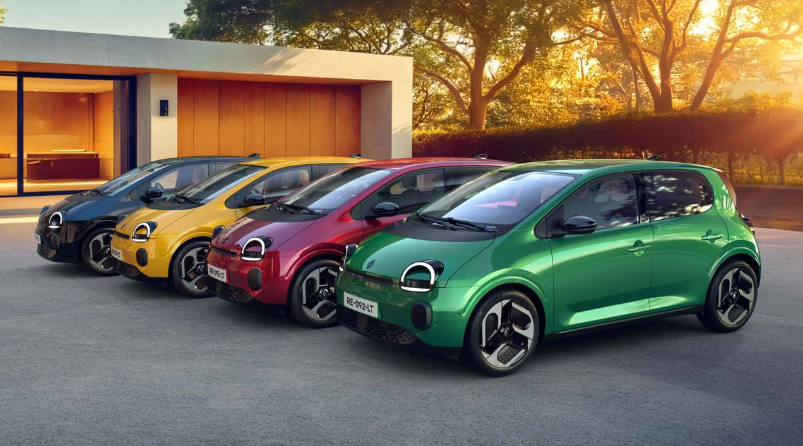
The 1990s are back, and they’ve gone electric. Renault has officially pulled the covers off the production-ready Renault Twingo E-Tech, a car that proves budget-friendly electric vehicles (EVs) don’t have to be boring. By blending “retro-chic” design with modern efficiency, the new Twingo is set to become the ultimate companion for city dwellers.
While the original Twingo became a cult classic for its “smiling” face and clever use of space, the 2026 model aims to do the same for the electric era.
A Design That Makes You Smile
The first thing you’ll notice about the new Twingo is its personality. Renault designers have stayed remarkably true to the first-generation 1992 concept, featuring:
- Circular LED Headlights: A direct nod to the “frog-like” eyes of the original.
- Three Hood Vents: Originally used for air intake, these now serve as a visual battery level indicator.
- Vibrant Colors: Expect bold shades like Mango Yellow and Mint Green that stand out in a sea of grey SUVs.
Despite its compact footprint, it now features five doors for the first time in this retro format, making it far more practical for small families or friend groups.
Performance: Tailored for the City
The Twingo isn’t trying to be a long-distance cruiser. Instead, it is engineered for the urban jungle darting through narrow streets and squeezing into tiny parking spots.
Battery and Range
Underneath is the AmpR Small platform, featuring a 27.5 kWh Lithium Iron Phosphate (LFP) battery. This setup provides an official WLTP range of approximately 263 km (163 miles). For the average driver who travels less than 40 km a day, a single charge could last an entire week.
Power and Speed
- Electric Motor: Produces 82 HP (60 kW).
- 0–100 km/h: Roughly 12.1 seconds.
- Top Speed: Limited to 130 km/h (81 mph).
While those numbers might look modest, the instant electric torque makes it feel incredibly zippy at stoplights and in low-speed traffic.
Clever Interior: Small Outside, Big Inside
Inside, the Twingo revives the “Monospace” philosophy. The dashboard is minimalist yet cheery, featuring a 10-inch touchscreen running Google-based software and a smaller digital cluster for the driver.
Modular Space
The highlight of the cabin is the sliding rear seats. You can push them back for more legroom (perfect for two adults) or slide them forward to expand the 305-liter boot. The front passenger seat also folds completely flat, allowing you to carry long items like a surfboard or flat-pack furniture a rarity in a car this size.
Tech and Charging
Standard models come with a 6.6 kW AC charger, but the “Advanced Charge” pack is the one to get. It adds 11 kW AC charging and 50 kW DC fast charging, allowing you to go from 10% to 80% in just 30 minutes. It even supports V2L (Vehicle-to-Load), meaning you can plug in appliances like a coffee machine or a laptop directly into the car.
The Price Revolution
Renault’s biggest promise with the Twingo is affordability. It is positioned as the entry point to the brand’s EV lineup, sitting below the Renault 5 and Renault 4.
In Europe, the starting price is confirmed at €19,490 (approximately Rp 381 million). By keeping the price under the €20,000 mark, Renault is directly challenging budget competitors while offering a more premium, European-built feel.
Frequently Asked Questions
When will the Renault Twingo be released?
The Renault Twingo E-Tech made its production debut in late 2025 and is scheduled to hit the market in early 2026.
Does it have a front trunk (frunk)?
No. To maximize cabin space in such a small vehicle, Renault has packaged the electronics in the front, meaning all storage is located in the rear boot.
Is the Twingo bigger than the Renault 5?
No, the Twingo is the smallest EV in the Renault range. It is roughly 3.79 meters long, making it about 13 cm shorter than the Renault 5, which is better suited for those who need more highway stability.
Can it be charged at home?
Absolutely. On a standard 7 kW home wallbox, a full charge from 10% to 100% takes about 4 hours, making it ideal for overnight charging.
Will it come to Indonesia?
While Renault has focused its initial launch on Europe, there is strong interest in bringing affordable EVs to the Indonesian market. If launched, it would likely compete with the likes of the Wuling BinguoEV or Citroën e-C3.