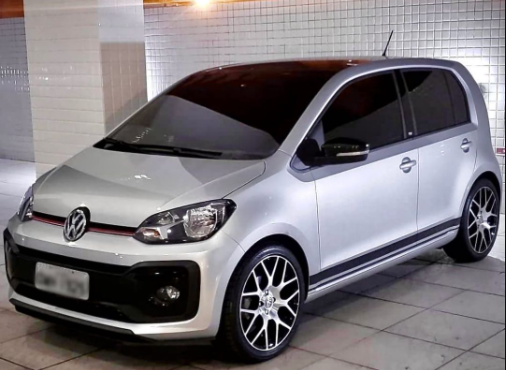
The Volkswagen Up! is a masterclass in how to build a small car without making it feel “cheap.” Since its debut, the Up! has been the benchmark for the city car segment, proving that compact dimensions can coexist with refined engineering and a premium feel. While production of the classic petrol model officially ended in late 2023, the Up! remains one of the most sought-after vehicles on the pre-owned market and a symbol of smart urban mobility.
Small Exterior, Big Personality
The brilliance of the Volkswagen Up! lies in its “wheels at the corners” design. By pushing the wheels to the absolute edges of the chassis, Volkswagen created a car that is incredibly easy to park but surprisingly spacious inside.
With a length of just 3.6 meters, it can slip into parking spots that larger SUVs wouldn’t even consider. Yet, once you step inside, the minimalist dashboard and clever packaging provide enough headroom and legroom for four adults to travel in relative comfort—a feat few competitors can match.
Performance: Zippy and Efficient
The Up! was designed primarily for the “urban jungle,” and its engine lineup reflects that focus:
- 1.0L Three-Cylinder Petrol: The mainstay of the range, offering between 60hp and 75hp. It is characterful, making a distinctive “thrum” that makes city driving feel surprisingly fun.
- The Up! GTI: A modern tribute to the original 1976 Golf GTI. With a turbocharged engine producing 115hp, it turns the tiny city car into a “pocket rocket” capable of 0–60 mph in 8.8 seconds.
- The e-Up! (Electric): The later models featured a 32.3 kWh battery, providing a real-world range of approximately 160 miles (260 km). For city dwellers with access to a charger, it is arguably the most refined version of the car.
“Simply Clever” Interior and Tech
Volkswagen didn’t try to cram expensive, oversized screens into the Up!. Instead, they opted for a “Bring Your Own Device” philosophy. Most models feature a smartphone cradle on the dashboard that connects to the car via Bluetooth, turning your phone into the infotainment and navigation hub through the Maps + More app.
The interior quality is classic Volkswagen: tactile buttons, a solid steering wheel, and body-colored metal panels on the doors that give the cabin a trendy, retro-modern vibe.
Why the Up! Still Makes Sense Today
Even though Volkswagen is moving toward its “ID” electric future (with the rumored ID.1 set to succeed the Up!), the original Up! remains a top choice for several reasons:
- Low Running Costs: It sits in some of the lowest insurance groups and offers excellent fuel economy (often exceeding 50 mpg).
- Safety First: Despite its size, it achieved a high Euro NCAP rating during its production, featuring multiple airbags and stability control as standard.
- Resale Value: Because of its reputation for reliability and build quality, the Up! holds its value significantly better than many of its rivals like the Hyundai i10 or Fiat 500.
Frequently Asked Questions
Is the Volkswagen Up! still being made?
Official production of the petrol and electric Up! ended in the fourth quarter of 2023. However, it remains widely available through the Volkswagen “Approved Used” network and second-hand markets.
Is the Up! good for motorway driving?
While it is designed for the city, the Up! is remarkably stable at highway speeds. Unlike many small cars, it doesn’t feel “flighty” or wind-swept, though the 1.0L engine will have to work harder for overtakes.
Does the VW Up! have a spare wheel?
Most models come with a tire repair kit (sealant and a compressor) to save space and weight, though a space-saver spare wheel was available as an option on some trims.
What is the difference between the 3-door and 5-door versions?
Mechanically, they are identical. The 5-door version is much more practical for carrying passengers, while the 3-door version is often praised for having a slightly sleeker, more balanced profile.
Which model is best for a first-time driver?
The standard 1.0 Move up! or High up! is ideal. They offer the best balance of features (like air conditioning and alloy wheels) while keeping insurance premiums at their lowest.